We work with facility managers and safety teams to make sure electrical work and maintenance programs meet the standards that protect your people and your operation.
NFPA 70E & NFPA 70B Compliance Services in Bakersfield, CA & Boise, ID

NFPA 70E and NFPA 70B aren’t bureaucratic checkboxes — they’re the standards that define how electrical work and electrical maintenance are performed safely in commercial and industrial environments.
Bronco Electric holds current NFPA 70E arc flash safety certifications and maintains NFPA 70B-aligned maintenance practices across everything we do. For facility managers and safety officers who need an electrical contractor that understands and operates within these standards, that’s not a claim we make for marketing purposes; it’s how our team works on every job.
An Electrical Contractor That Treats NFPA 70E and 70B as Operating Standards
Certification matters. So does actually applying what it requires on every job.A lot of electrical contractors list NFPA 70E certification as a credential. Fewer consistently apply what it requires across every commercial and industrial job their team performs. That includes service calls, maintenance visits, and repair work where energized electrical equipment is involved. We treat NFPA 70E compliance as a non-negotiable operating standard, not a credential that gets mentioned in proposals and forgotten on the job site.
Our commercial preventative maintenance programs are structured around NFPA 70B practices. You can expect defined inspection and testing procedures, documented findings, and maintenance records that give facility managers a defensible history of how their electrical systems have been maintained. That documentation has value beyond the maintenance itself.
Bronco Electric maintains current certifications across our electrical workforce and pursues new certifications continuously, because commercial and industrial clients who specify NFPA-compliant contractors deserve a team whose credentials are actually current.
Understanding Safety Standards and Compliance
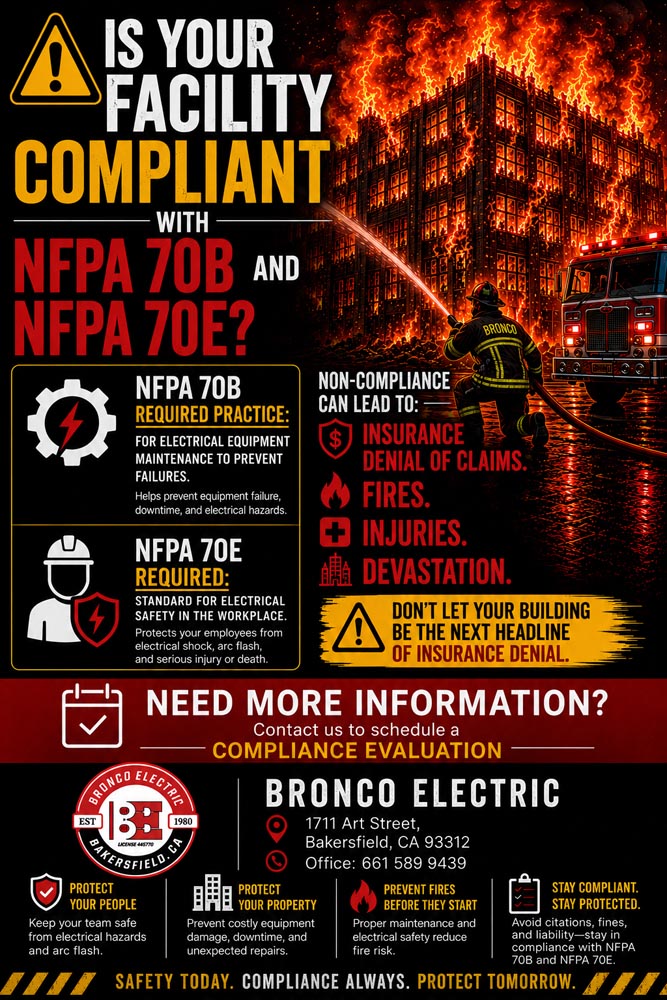
NFPA 70E addresses electrical safety in the workplace, specifically the safe work practices, PPE requirements, and hazard analysis procedures that apply when workers are performing tasks on or near energized electrical equipment.
NFPA 70B addresses electrical equipment maintenance. It focuses on the practices and procedures for keeping electrical systems in a safe, reliable operating condition through structured inspection and testing programs.
The two standards are complementary: 70E governs how the work is performed safely, and 70B governs how electrical systems are maintained to reduce the risk of failures and hazardous conditions developing over time.
NFPA 70E applies wherever electrical workers perform tasks on or near energized equipment, but the facilities where compliance is most critical and most closely scrutinized include:
- Industrial facilities — manufacturing plants, pump stations, water treatment operations
- Healthcare facilities where electrical systems cannot be de-energized without affecting patient care
- Data centers and facilities where continuous uptime requirements limit de-energization opportunities
- Commercial properties with large electrical services and switchgear
- Any facility where OSHA compliance is actively monitored or where electrical safety incidents would trigger regulatory scrutiny
For these facilities, working with an NFPA 70E-certified electrical contractor isn’t optional — it’s a fundamental requirement.
An arc flash is a sudden, explosive release of energy caused by an electrical fault — producing intense heat, a pressure wave, molten metal, and light that can cause severe burns, blast injuries, and death within fractions of a second.
Arc flash incidents are among the most serious electrical workplace hazards. NFPA 70E was developed specifically to establish the safe work practices, hazard analysis requirements, and PPE standards that reduce the risk of arc flash injury to workers performing tasks near energized electrical equipment.
Understanding arc flash hazards and working within NFPA 70E requirements is a baseline expectation for any electrician performing commercial or industrial electrical work.
We’re Here to Handle Your NFPA 70E and 70B Standards
Bronco Electric provides NFPA 70E and NFPA 70B compliant electrical services and maintenance programs for commercial and industrial facilities across Bakersfield, California, and Boise, Idaho. If your facility requires certified electricians who apply these standards on every job — not just in their credentials — we’re ready to talk.
Full-Service Electrical Expertise
From large-scale commercial and industrial construction to ongoing system support, our team delivers complete electrical solutions built around performance, safety, and long-term reliability. While we’re trusted on complex job sites, we also bring that same level of expertise to residential service work — giving homeowners access to high-level electrical knowledge typically reserved for larger projects.